
Curatorial text by Yijing Li
In Between Lights explores how alternative photographic practices translate time through light, material, and transformation. Bringing together the work of Ursula Handleigh, Julia Rose Sutherland and Michael Flomen, the exhibition traces three distinct approaches to photography through camera-less image making, plant-based materials, and photographic transfers onto birch bark. Together, these works reconsider photography not as a medium that fixes moments, but as one that reveals time through processes of change and material transformation. The exhibition is curated by Yijing Li and runs from July 9–23, 2026 at artLAB Gallery, with an opening reception on July 9 from 5:00–7:00 PM.
For much of photography’s history, light has been understood as a tool—a means of recording, preserving, and fixing the world before it disappears. Through light, photographs promise to archive what would otherwise be lost, transforming fleeting moments into evidence and memories into objects that can be revisited.
Yet light has always existed before photography. Long before the invention of cameras, light was already moving across landscapes, touching water, stone, leaves, skin, and bodies.
This realization gradually emerged through conversations with Michael Flomen, Ursula Handleigh, and Julia Rose Sutherland. Each approaches photography differently, yet all three ask a similar question: What happens when we stop treating light as something we use and begin encountering it as something with its own temporality?
In Michael Flomen’s studio, we spoke about fireflies. They are only one constellation within his larger body of work, yet they became the point from which our conversation unfolded.
His photograms are not photograms of fireflies. They are photograms made with fireflies. The insects are not subjects positioned before a camera; their bioluminescent movements generate the image itself. Light traces its own path across photogram. Looking at these images, I was reminded of László Moholy-Nagy’s belief that photography could reveal dimensions of reality inaccessible to ordinary perception. Yet Flomen’s work seems to push this proposition further. What remains on the photogram is not a frozen instant but the accumulation of movements through darkness. Time leaves a trace.
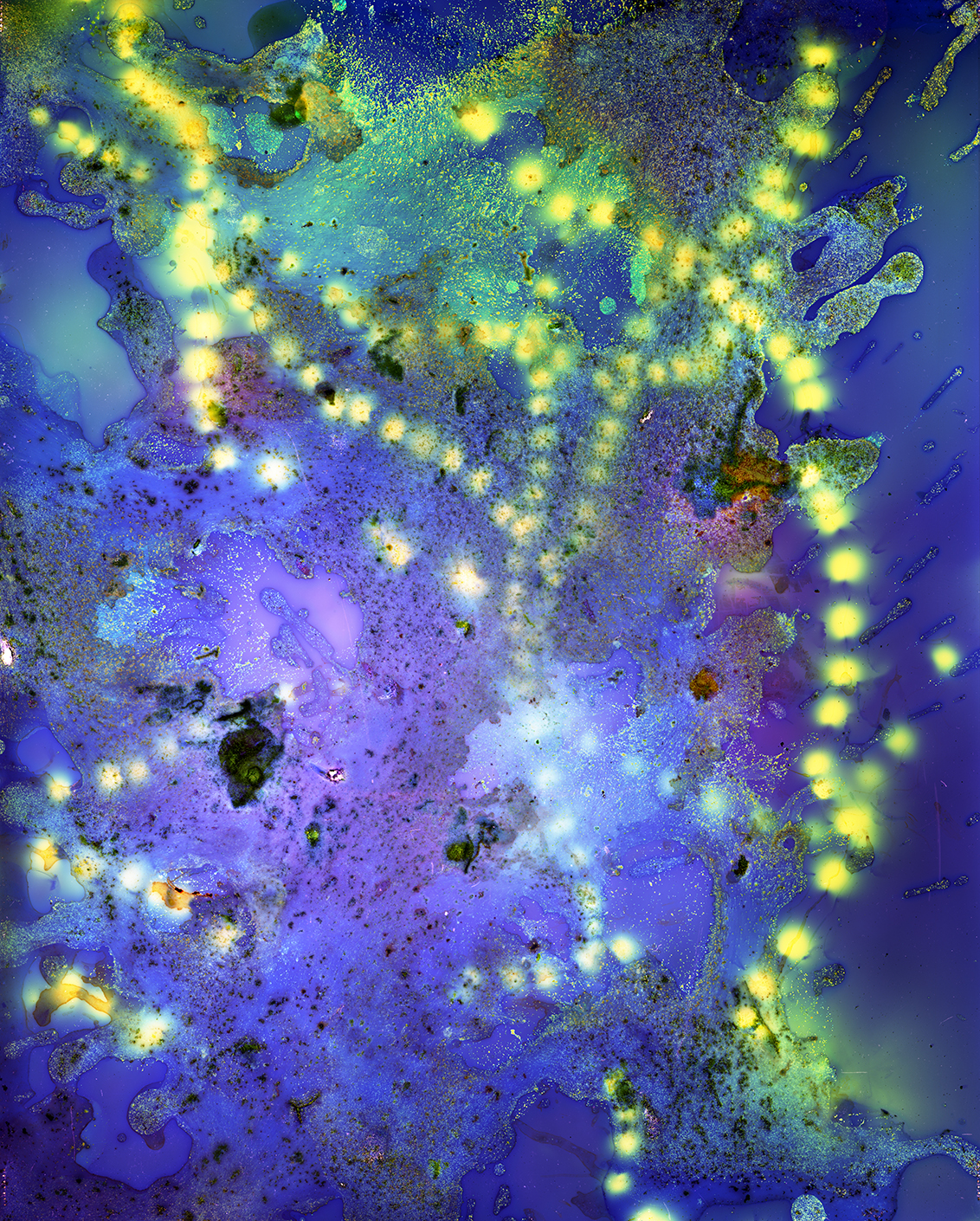
If Flomen’s work allows us to see the movement of time, Ursula Handleigh’s practice invites us to inhabit its rhythms through life cycle.
When I visited Ursula Handleigh’s studio, I found myself thinking less about photography and more about the rhythms of everyday life. Her works emerge slowly through sunlight, plant-based photographic processes, and repetitive gestures of labour. Contact prints of banana leaves are exposed in natural sunlight, developed through a solution made from banana leaves, cut into photographic strips, and woven together through the Indigenous Matrilineal Filippine craft of Banig, passed down through her maternal lineage. Photography does not end when the image appears. It continues through the hands. Fragmented images slowly become a cohesive whole. The rhythm of weaving unfolds between conversations, caregiving, meals, household work, and changing weather. Over, under, pull, tighten, repeat. Each gesture accumulates. Each movement carries memory forward.
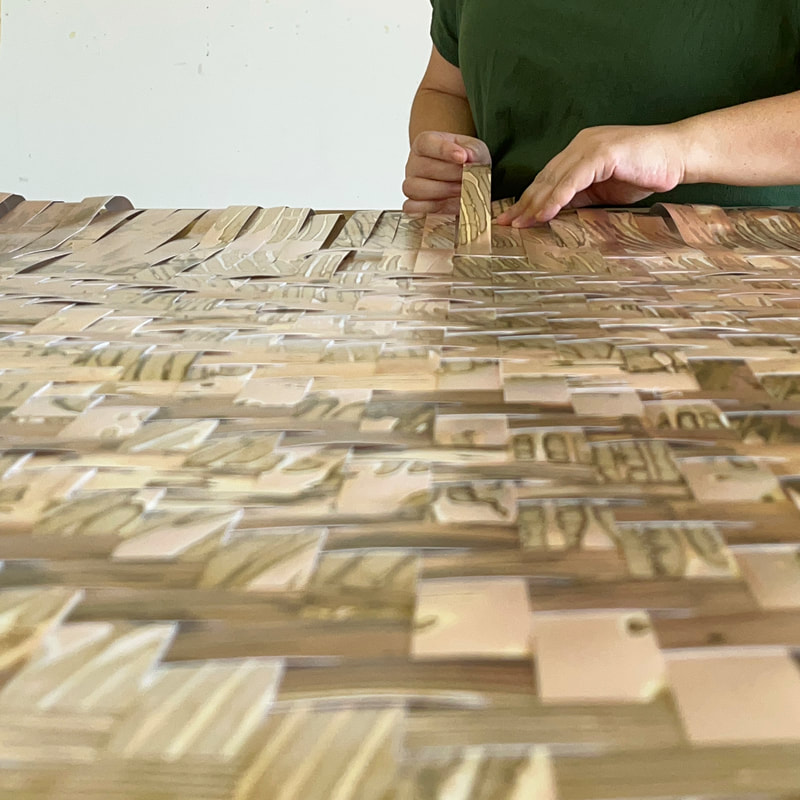
What interests me most is how sunlight participates in this process. Unlike conventional photography, where light often serves the photographer’s intention, sunlight here remains an active collaborator. The image emerges through exposure, weather, and time, while weaving extends the photographic process beyond the instant of capture. Rather than preserving a fixed memory, the work invites memory to remain in motion. Looking at these works, I began to wonder whether photographs endure not because they resist change, but because they continue to transform through the relationships that sustain them.
A similar understanding appears in the work of Julia Rose Sutherland. Family photographs migrate onto hand-peeled birch bark, a material that bears its own histories, markings, scars, and vulnerabilities. The bark resembles skin—not only visually, but conceptually. Like skin, it records encounters. It carries traces of growth, weather, touch, and time. Marked by its relationship to the land, the birch bark becomes more than a surface for receiving images; it becomes a living body that remembers.

Photographic images arrive not upon a neutral support but upon a material already shaped by experience. Family histories move from paper to bark, from one generation to another, from one body to another. The work is further held together by hand-sewn beadwork that traces its edges, while deer hide on the reverse introduces another living material into the photograph’s structure. In this translation, memory is not preserved unchanged. It settles into surfaces that continue to age, mark, and transform. Like skin carrying scars and traces of lived experience, the birch bark carries memory forward without holding it still.
Across these conversations, I began to notice a shared proposition. Photography is not understood as a technology that captures time. Instead, these artists allow time to remain present within the work itself. Perhaps this is what photography has been doing all along. Not recording time, but translating duration into traces, translating memory into material. Translating change into forms we can briefly perceive before they too continue their transformation.
The works gathered in the exhibition In Between Lights invite us into this space of translation. They ask us to slow down, to attend to subtle shifts, and to recognize that photography is not always an act of taking. Sometimes it is a way of remaining present with processes that unfold beyond our control.
—
Yijing Li is a Ph.D. candidate in Art and Visual Culture (Curatorial Stream) at Western University. Her research explores alternative photographic practices, materiality, and ecological approaches to curating, with a particular focus on how light translates time through photography. In Between Lights forms part of her doctoral research and is her sixth curated exhibition.
 SATELLiTE
You must be logged in to post a comment.